
Table of Contents
Which Elastic Email Product and Plan Should You Choose?
In Elastic Email, you have three products to select from - Email Marketing and Email API. For the first two products, you can choose a Free, Starter or Pro plan. Depending on your goals, you can choose the one that best fits your needs, and we'll help guide you to the right choice. While many features are similar, there are small distinctions that could be significant. Let's see what to focus on!
Table of Contents
- TL;DR
- Getting Started with Elastic Email
- Email API vs. Email Marketing: what's different
- What's unique to Email API - API calls, different pricing structure, and no campaign creator
- What both products include
- Email Marketing: Starter vs. Pro - automation, custom fields, user management, and more
- Email API: Starter vs. Pro - webhooks, cRDN, and inbound email processing
- Which plan should you choose?
- Summary
- FAQ
TL;DR
Elastic Email has two products. Email Marketing is for building and sending campaigns from a dashboard, and prices on contacts plus volume. Email API is for applications that send email programmatically, has no campaign creator, and prices on volume alone. Each comes in Free, Starter and Pro. At the entry tier, Starter and Pro include the same sending volume - Pro adds features: automation, custom fields, user management and branding on Email Marketing; webhooks, inbound processing and a Custom Return-Path Domain on Email API. Start on Free and upgrade when you need those features. You can switch at any time.
Getting Started with Elastic Email
Setting up your Elastic Email account is extremely easy. You can test it, see crucial functions, and send the first emails.
Essential questions to ask yourself before choosing a product and plan:
- What is your estimated monthly email volume?
- How many unique contacts do you send to?
- What domain or website will you be sending from?
- What type of emails do you intend to send?
- Do you need to use our contact and campaign design tools to send campaigns?
- Are you currently using another provider to send emails?
- Are you a content creator?
Starting from the top, what distinguishes the three products? While they offer similar functionalities and the dashboards look quite alike, there are some key distinctions you need to consider. Let's dive into what makes the difference.
Email API vs. Email Marketing: what's different
The Email Marketing product is probably more versatile and doesn’t require coding skills to use it fully. With this product, you can also generate an API key or SMTP credentials, allowing you to take advantage of API connections or SMTP relay. It’s simple to manage your contacts and grow your audience without additional CRM. You can easily create lists and dynamic segments based on specific criteria to create smaller bunches of your recipients. With status management, you can easily identify your most engaged or inactive audience and use this information for your campaigns.
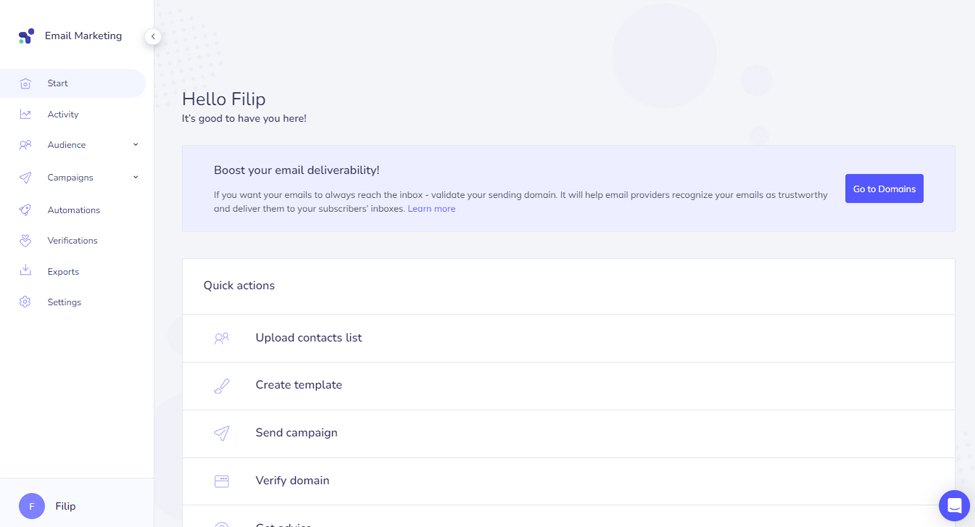
Collecting contacts via forms (our product provides a free form builder – we're also working on an exciting update here!) or landing pages (featuring a free block-based landing page builder) is a piece of cake, even without technical skills. However, there's a crucial difference – you can't send campaigns from the dashboard within the API product, as that feature is reserved for the Email Marketing product. With the API, you'll probably need an external tool like Postman or a plugin like Post SMTP. Both methods are easy if you know coding, but using our built-in campaign creator is probably simpler, especially for tasks like A/B testing.
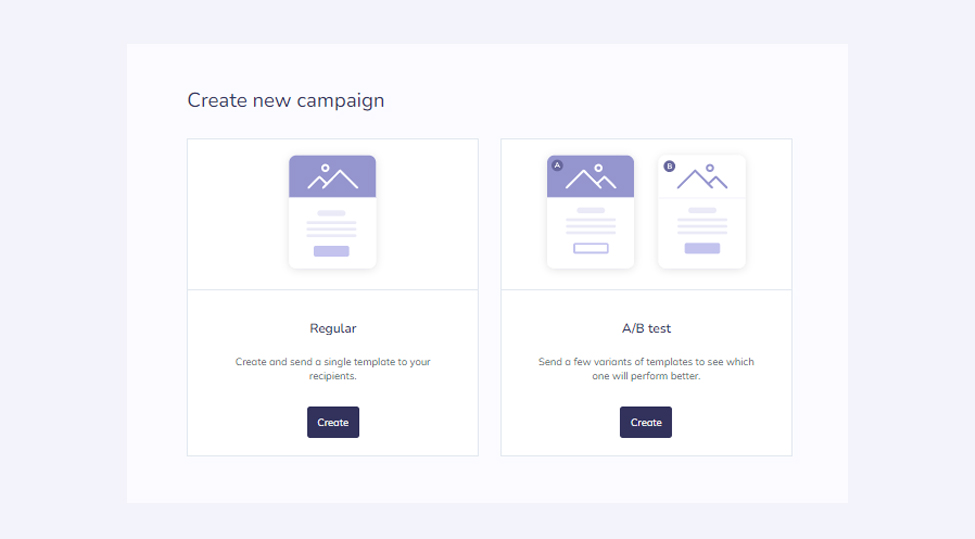
What's unique to Email API - API calls, different pricing structure, and no campaign creator
In the API product, you have access to suppression management instead of contact management. All your activities should be based on API calls (we offer comprehensive API documentation) or SMTP connections with external apps or plugins. Instead of campaigns, there are channels that can be reviewed in the log section to see the results of your sending. However, log retention is the same regardless of the product - depending on the plan, it is 3 days (Starter) or 7 days (Pro).
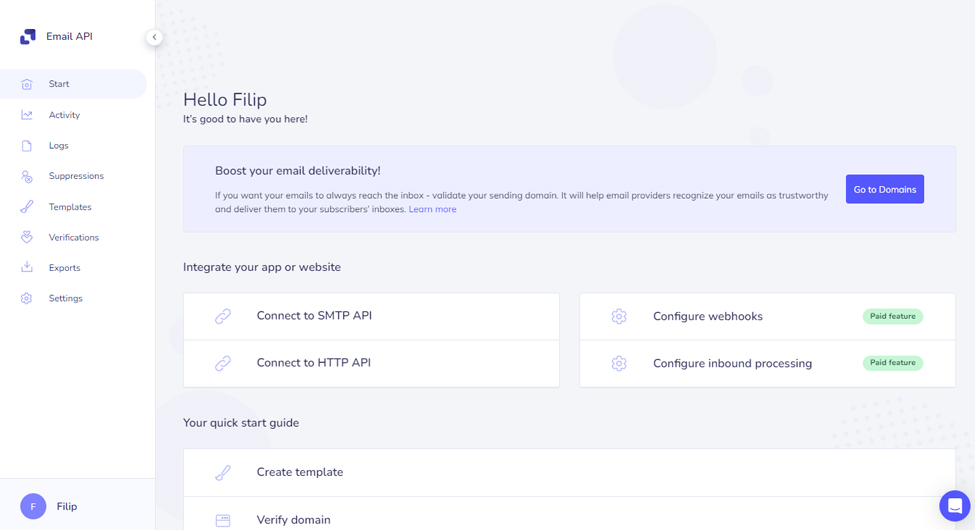
The biggest difference is probably in the pricing structure. In Email Marketing, costs depend on two metrics: the number of contacts and the volume of emails sent. For instance, in the Starter Plan, you can send up to 450,000 emails to 30,000 contacts for $219. In contrast, the Email API pricing depends only on the number of emails sent each month, with no contact limit. For $209, you can send up to 700,000 emails, regardless of how many contacts you have.
What both products include
So, what do both our products have in common? First of all, both are awesome, and you should definitely test them out (especially since that’s totally for free!). Both use our own MTA and offer a high deliverability rate. With either product, you have access to our ultra-intuitive and effective email designer.
As mentioned earlier, you can generate up to 15 API keys and up to 15 SMTP credentials combined in both products.
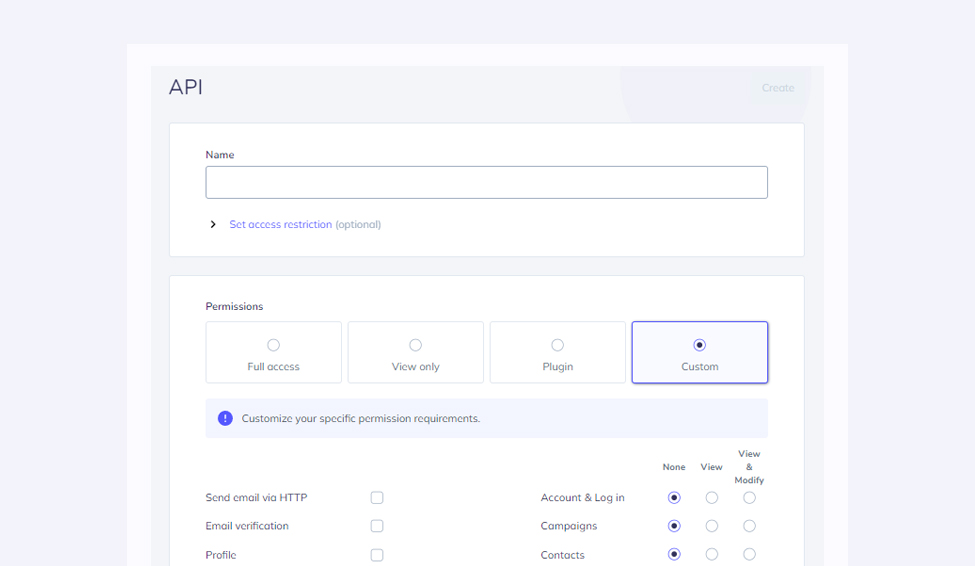
You can send emails directly from your domain and easily verify it with our guide. The AI text tool, which serves as your email writing assistant, is available for both Marketing and API products. The number of available prompts per month depends on the plan (30 in the Starter plan, 100 in the Pro plan).
In both products, you'll also find free email templates ready for immediate use and regularly updated with new designs. Additionally, private IPs are available for purchase regardless of the plan. This is a great way to enhance your deliverability as you'll have your own IP rather than being part of a shared pool, allowing you to completely manage its reputation. So, as you can see, there are a lot of similarities between them.
What's important is that customer support is free and available in every plan and product you choose. Our qualified specialists are here for you 24/7. Additionally, you can opt for additional dedicated support if time is critical for you.
Email Marketing: Starter vs. Pro - automation, custom fields, user management, and more
We'll be completely honest with you - PRO isn't always the better choice. While it's more advanced and certainly powerful in the hands of experienced professionals, sometimes the Starter plan is more than enough when you don't need additional functionalities.
By upgrading to Marketing Pro, you gain access to extra features, with one of the most significant being email automation. It allows users to create their own email automation workflows and minimize the time needed to create the funnels or client’s path. It becomes essential for implementing advanced automation strategies and designing various client interactions based on specific triggers.
Unlimited custom fields in the Marketing Pro plan can also be beneficial, especially if you want to create segments based on specific criteria and use more personalization in your campaigns.
User management and the ability to create sub accounts are also highly valued by our larger clients, particularly agencies or more advanced marketing teams where responsibilities are distributed among different individuals. In such cases, granular access control can be indispensable.
Reseller and custom branding are powerful tools if you aim to market our product to your clients. This is typical among advertising agencies or hosting companies that adopt Elastic Email software as their own and provide it to their customers.
Email API: Starter vs. Pro - webhooks, cRDN, and inbound email processing
It's similar to Email Marketing plans – reseller features, user management, and sub accounts are exclusive to the Pro plan. Therefore, if you aim to profit from selling Elastic Email software or need an efficient method to manage multiple users with detailed access to your account, the PRO plan is the way to go.
The Pro plan also includes setting up webhooks. These are used to send real-time data about specific events to a designated URL on the client's server. These events can include actions such as email opens, clicks, bounces, and unsubscribers. With this capability, you can integrate Elastic Email events into your applications and automate responses to various email-related activities.
An important feature for our PRO clients is cRDN, which stands for Custom Return-Path Domain (Custom Bounce Domain in our app). It allows users to utilize their own domain for managing bounced emails and other email-related feedback. This ensures better control over email processing and can also enhance the reputation of specific domains.
Last but not least - inbound email processing. This feature, reserved for the Pro plans of both products allows users to receive and process emails sent to their domain. It helps in handling support emails, automated responses, and processing incoming data.
Which plan should you choose?
Your ultimate selection of product and plan should align with your goals, capabilities, and understanding. Keep in mind that you can upgrade or downgrade at any time.
If I were a small business or the only employee in the marketing team, I would probably prefer the Marketing Starter plan. It allows for easy growth of the contact list, management of specific recipients, and creation of campaigns.
If I were a more advanced email marketer or member of an email marketing agency, my focus would be on the Pro plan. Email automation would likely be the most significant factor for me, but I would also prioritize user management and reseller features.
If I were a developer or had programmers on my team/company, I would stick with the API product. Depending on my coding skills or the features I need, I would choose between the Pro and Starter plans.
E-commerce can be particularly challenging. If the main goal is strictly sending transactional emails, the Email API plan would be my preference. However, if these actions need to integrate with newsletters and product marketing via email, then the Email Marketing Starter plan emerges as the optimal solution. On the other hand, if I were in search of more advanced features and desired additional personalization and automation in my marketing efforts, the Email Marketing Pro plan would be my preferred option.
Summary
As you can see, there are plenty of options to pick from!
To sum up, the API plan is likely better suited for individuals comfortable with programming or who have programmers on their team. If your primary need is to connect or integrate with various tools, then using an API key or SMTP with this product would be more appropriate. Alternatively, the Email Marketing plan, with its campaign creator and email automation features, might be a better fit, especially if your team includes individuals who manage external connections and those who focus on sending campaigns and newsletters without technical skills.
It's worth mentioning that with our in-app and email onboarding, learning how to use our tool should be easy, regardless of which plan or product you choose. We provide video and email tutorials that will guide you step by step through the most important stages.
We hope that you will make the right decision! Remember that you can try both products for free at any time.
Enjoying this Content?
You can receive articles like this straight to your inbox.
Sign up for our newsletter and get a dose of email marketing knowledge every month!
FAQ
If you like this article, share it with friends:


Filip Blajet
Filip is a marketing specialist and content author, who spends a lot of time with data and ads. Outside of work, he loves football, binge watching tv series and travelling.


Eager to put this knowledge to some use?
Try one of our products!


